The Kindly Ones, three powerful beings also known as the Furies. They have the power to even harm the Endless, if they should be summoned to do so by a mortal with a just grievance...and if that member of the Endless has spilled the blood of one of their own family. When Lyta Hall's young son Daniel goes missing, she blames Dream and calls upon the Kindly Ones for aid. When they agree - for Dream has the blood of his own son on his hands - a sequence of events is set in motion which will profoundly change everything.
The Kindly Ones is the ninth of the Sandman graphic novels and is also the largest. It is a sustained storyline, originally published across thirteen issues of the title's original comics run. It was also deliberately written by Neil Gaiman to be read as a single graphic novel, a decision that provoked the ire of some readers of the comic who felt that many of the individual issues failed to satisfy when taken on their own merits. However, read as a single story it becomes clear that The Kindly Ones may be the strongest of The Sandman's long storylines.
The Kindly Ones takes no prisoners. Previously, Gaiman was careful to reintroduce older characters in a way that newer readers would still be able to follow and enjoy what was going on. He has no truck with that here, instead pulling together dozens of characters and narrative strands from earlier issues and collections. These storylines include: the aftermath of Dream's slaying of his son Orpheus, Delirium's acquisition of a talking dog named Barnabas; the saga of Lyta Hall and her infant son Daniel; the relationship between Dream and the witch Thessaly; the retirement of Lucifer as Lord of Hell and his vow to destroy Dream; Desire's long-standing ire with his/her brother; the adventures of the faerie lord Cluracan and his sister Nuala; the resurrection of the Corinthian; the misadventures of Rose Walker; and numerous subplots involving the inhabitants of the Dreaming, including Cain and Abel, the raven Matthew, the librarian Lucien and handyman Mervyn. It's a challenging juggling act which Gaiman pulls off with skill, by drawing the various narratives together in often surprising ways. The story also revisits the very beginnings of The Sandman, with the manor house where Dream spent seventy years imprisoned figuring prominently.
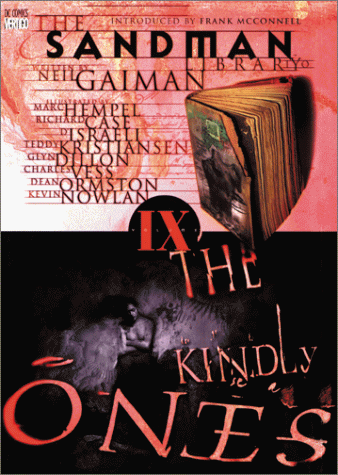
As well being a feast for continuity lovers, the collection also delivers its own thematic arc: this is a Greek tragedy, pure and simple. Events build slowly and with growing intensity towards an ending that is not actually that inevitable, but only becomes so when the Sandman refuses to allow himself to deviate from what he sees as his own responsibilities and obligations. A key theme referred to throughout the comics, but much more prevalent here, is that the Sandman used to be far too rigid for his own good, but has changed since his imprisonment by humans. The Kindly Ones shows how far he has changed...and how far he has to go. As a result, The Kindly Ones offers the most insight into the character of Dream himself, even when he is not actually on the page. Other characters are also well-served, with even minor players from earlier issues getting moments to shine.
The art style in the collection has attracted a lot comment. It's an interesting choice, giving the largest and most coherent Sandman storyline the most stylised and perhaps 'weird' art style in the history of the series. The juxtaposition of the heavy drama and odd art style actually works well, with the art tying in well with the more oddball moments of the story (such as Cluracan giving birth to his own nemesis).
The Kindly Ones (*****) is Neil Gaiman at the top of his game, delivering the rich and powerful climax (though not the conclusion) that The Sandman deserves. The collection is available now in the UK and USA, and as part of The Absolute Sandman, Volume IV (UK, USA).
Showing posts with label the sandman. Show all posts
Tuesday, 15 January 2013
Sunday, 2 December 2012
The Sandman: Worlds' End by Neil Gaiman
Two travellers are driving across the United States, headed for Chicago. An unseasonable storm strands them at an inn, known as Worlds' End. Within waits a collection of fellow travellers from many worlds, all waiting for the storm to end. To pass the time they tell stories, stories from many worlds and many times.
Worlds' End is the eighth Sandman collection. It's a collection of self-contained short stories, but the stories feature recurring motifs. They are being told against the backdrop of a 'reality storm' that has been triggered by a cataclysmic event somewhere else in the multiverse (and, although a strong clue is given, we will not find out the nature of that event until the end of the following volume). It's Neil Gaiman's last chance to really exercise his imagination at short lengths before the beginning of the subsequent story arc, Sandman's largest and most epic, The Kindly Ones.
Worlds' End features a succession of stories, told by and featuring characters both new and familiar from the Sandman mythos. 'A Tale of Two Cities' is told in a minimalist art style, mostly through prose accompaniment, and features a traveller who loves his city so much that he becomes trapped in its dreams. It's weird and offbeat, and will probably appeal a lot to fans of China Mieville.
'Cluracan's Tale' features the return of the elf Cluracan, whose story is a bonkers collection of trickery, deception and a swordfight that may or may not have happened. It's lightweight (and Gaiman's not a huge fan of it, feeling it was too big for his page count and was consequently diminished in its impact) but fun. 'Hob's Leviathan' features a traditional narrative device, of a youngster running away to sea, and the return of one of the more popular Sandman characters, Hob Gadling, who was gifted with immortality by Dream and who meets him once a century to catch up. In this story, Hob is a passenger on a ship where the journey takes a turn for the very strange. It's a smart and tight story, with a couple of twists that are perhaps predictable but pulled off so well it doesn't really matter.
In 'The Golden Boy' Gaiman resurrects the fairly obscure DC character Prez Rickard, the first teenage President of the United States of America (running on an independent ticket). Set in an alternate United States, Prez becomes the embodiment of the hopes that Americans apparently place in their leaders: a virtuous man who helps the poor and needy without impoverishing the country, and manages to lower its debts. He resists corruption and survives tragedy (an attempted assassination that takes the life of his fiancee). A story about such a paragon sounds boring, but Gaiman infuses it with wit and some amusing lines and cultural references, not mention several nods to his friend Alan Moore's Watchmen. He also solves a minor puzzle about Dream that had been left dangling for almost five years by that point.
The next story, 'Cerements', is the most complex. Given there are nods in it to the work of Gene Wolfe - the inhumers share some similarities with the guild of torturers in The Book of the New Sun - this is to be expected. It is a tale told by Petrefrax, a prentice inhumer from the Necropolis Litharge. But within his tale, three others tell their tales (one of which contains a short story in itself). The result is a complex Russian's doll of narratives nestled within one another, seemingly disconnected but featuring some key insights into the Endless and (another recurring element in these stories) the nature of how they die. Compared to Cluracan's story (which is lightweight but baggy), 'Cerements' is fiendishly complex but told with impressive economy.
At the end of the collection - after a meta-aside in which a woman at the inn complains about the sexism of the story-tellers - the storm ends with a haunting vision of vast figures in the sky, a clue as to what caused the storm and the event that will drive the remainder of the series.
Worlds' End uses a familiar device (influenced by The Canterbury Tales) but does so with wit and intelligence. The stories are decent, with Cluracan's perhaps being the least memorable, and feature some wonderful fantastical imagery. 'The Golden Boy' also flirts with politics, not the nitty-gritty of ideologies, but what people want from their leaders, no matter how unrealistic. There is also a feeling of doom overhanging the collection, of events, no matter how seemingly disconnected, being linked to a tragedy whose own story is yet to be told.
Worlds' End (****½) is one of the stronger Sandman collections and is available now in the UK and USA, and as part of Volume III of The Absolute Sandman (UK, USA)
Worlds' End is the eighth Sandman collection. It's a collection of self-contained short stories, but the stories feature recurring motifs. They are being told against the backdrop of a 'reality storm' that has been triggered by a cataclysmic event somewhere else in the multiverse (and, although a strong clue is given, we will not find out the nature of that event until the end of the following volume). It's Neil Gaiman's last chance to really exercise his imagination at short lengths before the beginning of the subsequent story arc, Sandman's largest and most epic, The Kindly Ones.
Worlds' End features a succession of stories, told by and featuring characters both new and familiar from the Sandman mythos. 'A Tale of Two Cities' is told in a minimalist art style, mostly through prose accompaniment, and features a traveller who loves his city so much that he becomes trapped in its dreams. It's weird and offbeat, and will probably appeal a lot to fans of China Mieville.
'Cluracan's Tale' features the return of the elf Cluracan, whose story is a bonkers collection of trickery, deception and a swordfight that may or may not have happened. It's lightweight (and Gaiman's not a huge fan of it, feeling it was too big for his page count and was consequently diminished in its impact) but fun. 'Hob's Leviathan' features a traditional narrative device, of a youngster running away to sea, and the return of one of the more popular Sandman characters, Hob Gadling, who was gifted with immortality by Dream and who meets him once a century to catch up. In this story, Hob is a passenger on a ship where the journey takes a turn for the very strange. It's a smart and tight story, with a couple of twists that are perhaps predictable but pulled off so well it doesn't really matter.
In 'The Golden Boy' Gaiman resurrects the fairly obscure DC character Prez Rickard, the first teenage President of the United States of America (running on an independent ticket). Set in an alternate United States, Prez becomes the embodiment of the hopes that Americans apparently place in their leaders: a virtuous man who helps the poor and needy without impoverishing the country, and manages to lower its debts. He resists corruption and survives tragedy (an attempted assassination that takes the life of his fiancee). A story about such a paragon sounds boring, but Gaiman infuses it with wit and some amusing lines and cultural references, not mention several nods to his friend Alan Moore's Watchmen. He also solves a minor puzzle about Dream that had been left dangling for almost five years by that point.
The next story, 'Cerements', is the most complex. Given there are nods in it to the work of Gene Wolfe - the inhumers share some similarities with the guild of torturers in The Book of the New Sun - this is to be expected. It is a tale told by Petrefrax, a prentice inhumer from the Necropolis Litharge. But within his tale, three others tell their tales (one of which contains a short story in itself). The result is a complex Russian's doll of narratives nestled within one another, seemingly disconnected but featuring some key insights into the Endless and (another recurring element in these stories) the nature of how they die. Compared to Cluracan's story (which is lightweight but baggy), 'Cerements' is fiendishly complex but told with impressive economy.
At the end of the collection - after a meta-aside in which a woman at the inn complains about the sexism of the story-tellers - the storm ends with a haunting vision of vast figures in the sky, a clue as to what caused the storm and the event that will drive the remainder of the series.
Worlds' End uses a familiar device (influenced by The Canterbury Tales) but does so with wit and intelligence. The stories are decent, with Cluracan's perhaps being the least memorable, and feature some wonderful fantastical imagery. 'The Golden Boy' also flirts with politics, not the nitty-gritty of ideologies, but what people want from their leaders, no matter how unrealistic. There is also a feeling of doom overhanging the collection, of events, no matter how seemingly disconnected, being linked to a tragedy whose own story is yet to be told.
Worlds' End (****½) is one of the stronger Sandman collections and is available now in the UK and USA, and as part of Volume III of The Absolute Sandman (UK, USA)
Monday, 19 November 2012
The Sandman: Brief Lives by Neil Gaiman
Delirium of the Endless has resolved to find her missing brother, Destruction. She asks for the help of her family, but the only one to respond positively is Dream. Recently dumped by a mortal woman, Dream needs something to take his mind off moping and decides this quest is the answer. He and Delirium set out on what promises to be an adventure...until people start dying and Dream is asked the impossible by his son.
Brief Lives is the seventh volume in the Sandman series, picking up after the events of the Fables and Reflections collection. In particular, it expands on the story Orpheus in which Dream's son awoke the rage of the Furies and was left in a dire predicament. Dream, who has been changed more than he will care to admit by a century's imprisonment at the hands of a mortal, finds himself in a situation where he requires Orpheus's help but the price that is asked in return is dire. This in turn has grave consequences that will extend across the remainder of the series's run. This dark undercurrent gives Brief Lives a lot of weight for something that starts off as a light-hearted adventure (or at least as close as Sandman ever gets).
The collection has a number of memorable characters, such as Destruction's laconic talking dog Barnabas, but it's Delirium who receives the most attention and development. Delirium talks in non-sequiturs and apparently has the attention span of a five-year-old, but during the course of the story we learn more about her and how she sees the world. We also get interesting glimpses of her former life as Delight, before she changed (for reasons even the other Endless do not understand). The collection also delves deeply into the purpose and nature of the Endless, explaining who they are and what they do. Destruction's conclusions about the Endless are somewhat disheartening and led to his self-imposed exile, but Dream does not accept those arguments (although Delirium does...but still maintains her duties). Brief Lives is thus about lives and even how those measured in millennia still feel brief when the end comes. There's also the ongoing themes of redemption, responsibility and consequence that have formed the spine of the series since its beginnings.
As usual Gaiman's writing is accomplished and the graphic format forces him to conciseness (avoiding the problem of indulgence that has occasionally blighted his prose work, most notably in American Gods). Characterisation is deft, with Delirium getting the most attention but even briefly-appearing characters like Despair get moments of humanity that may force the reader to reappraise them. There's also some great comic moments, such as Dream's raven-who-was-once-a-man Matthew having to teach Delirium to drive (with chaotic results) and Dream, in full moping mode, conjuring a rainstorm just so he can go out and stand in it and look forlorn, to the amusement of his minions. The artwork is appropriately dreamlike, with artists Jill Thompson and Vince Locke nailing the surrealness of such locations as Delirium's realm. However, the artwork arguably works less well in depicting the real-world locations and Destruction, in particular, feels a little underwhelming after his larger-than-life first appearance (based on Brian Blessed in Blackadder) in the previous volume.
The only other issue of note is that the storyline featuring the tracking down of Ishtar feels a bit pointless. Gaiman raises the issues of femininity, empowerment and the suggestion that prostitution and religion (which were linked in ancient times in several cultures) were separated to prevent the rise of matriarchal power groups, all of which is fascinating, but also underdeveloped in the context of the story. Still, Ishtar's final dance is a powerful scene and one that has some resonance through the rest of the story.
Brief Lives (****) is a very solid instalment of The Sandman and is the one that proves the turning point of the entire saga (though this may not be immediately obvious). It is available now in the UK and USA. The stories in this collection are also included in The Absolute Sandman, Volume III (UK, USA).
Brief Lives is the seventh volume in the Sandman series, picking up after the events of the Fables and Reflections collection. In particular, it expands on the story Orpheus in which Dream's son awoke the rage of the Furies and was left in a dire predicament. Dream, who has been changed more than he will care to admit by a century's imprisonment at the hands of a mortal, finds himself in a situation where he requires Orpheus's help but the price that is asked in return is dire. This in turn has grave consequences that will extend across the remainder of the series's run. This dark undercurrent gives Brief Lives a lot of weight for something that starts off as a light-hearted adventure (or at least as close as Sandman ever gets).
The collection has a number of memorable characters, such as Destruction's laconic talking dog Barnabas, but it's Delirium who receives the most attention and development. Delirium talks in non-sequiturs and apparently has the attention span of a five-year-old, but during the course of the story we learn more about her and how she sees the world. We also get interesting glimpses of her former life as Delight, before she changed (for reasons even the other Endless do not understand). The collection also delves deeply into the purpose and nature of the Endless, explaining who they are and what they do. Destruction's conclusions about the Endless are somewhat disheartening and led to his self-imposed exile, but Dream does not accept those arguments (although Delirium does...but still maintains her duties). Brief Lives is thus about lives and even how those measured in millennia still feel brief when the end comes. There's also the ongoing themes of redemption, responsibility and consequence that have formed the spine of the series since its beginnings.
As usual Gaiman's writing is accomplished and the graphic format forces him to conciseness (avoiding the problem of indulgence that has occasionally blighted his prose work, most notably in American Gods). Characterisation is deft, with Delirium getting the most attention but even briefly-appearing characters like Despair get moments of humanity that may force the reader to reappraise them. There's also some great comic moments, such as Dream's raven-who-was-once-a-man Matthew having to teach Delirium to drive (with chaotic results) and Dream, in full moping mode, conjuring a rainstorm just so he can go out and stand in it and look forlorn, to the amusement of his minions. The artwork is appropriately dreamlike, with artists Jill Thompson and Vince Locke nailing the surrealness of such locations as Delirium's realm. However, the artwork arguably works less well in depicting the real-world locations and Destruction, in particular, feels a little underwhelming after his larger-than-life first appearance (based on Brian Blessed in Blackadder) in the previous volume.
The only other issue of note is that the storyline featuring the tracking down of Ishtar feels a bit pointless. Gaiman raises the issues of femininity, empowerment and the suggestion that prostitution and religion (which were linked in ancient times in several cultures) were separated to prevent the rise of matriarchal power groups, all of which is fascinating, but also underdeveloped in the context of the story. Still, Ishtar's final dance is a powerful scene and one that has some resonance through the rest of the story.
Brief Lives (****) is a very solid instalment of The Sandman and is the one that proves the turning point of the entire saga (though this may not be immediately obvious). It is available now in the UK and USA. The stories in this collection are also included in The Absolute Sandman, Volume III (UK, USA).
Subscribe to:
Posts (Atom)


